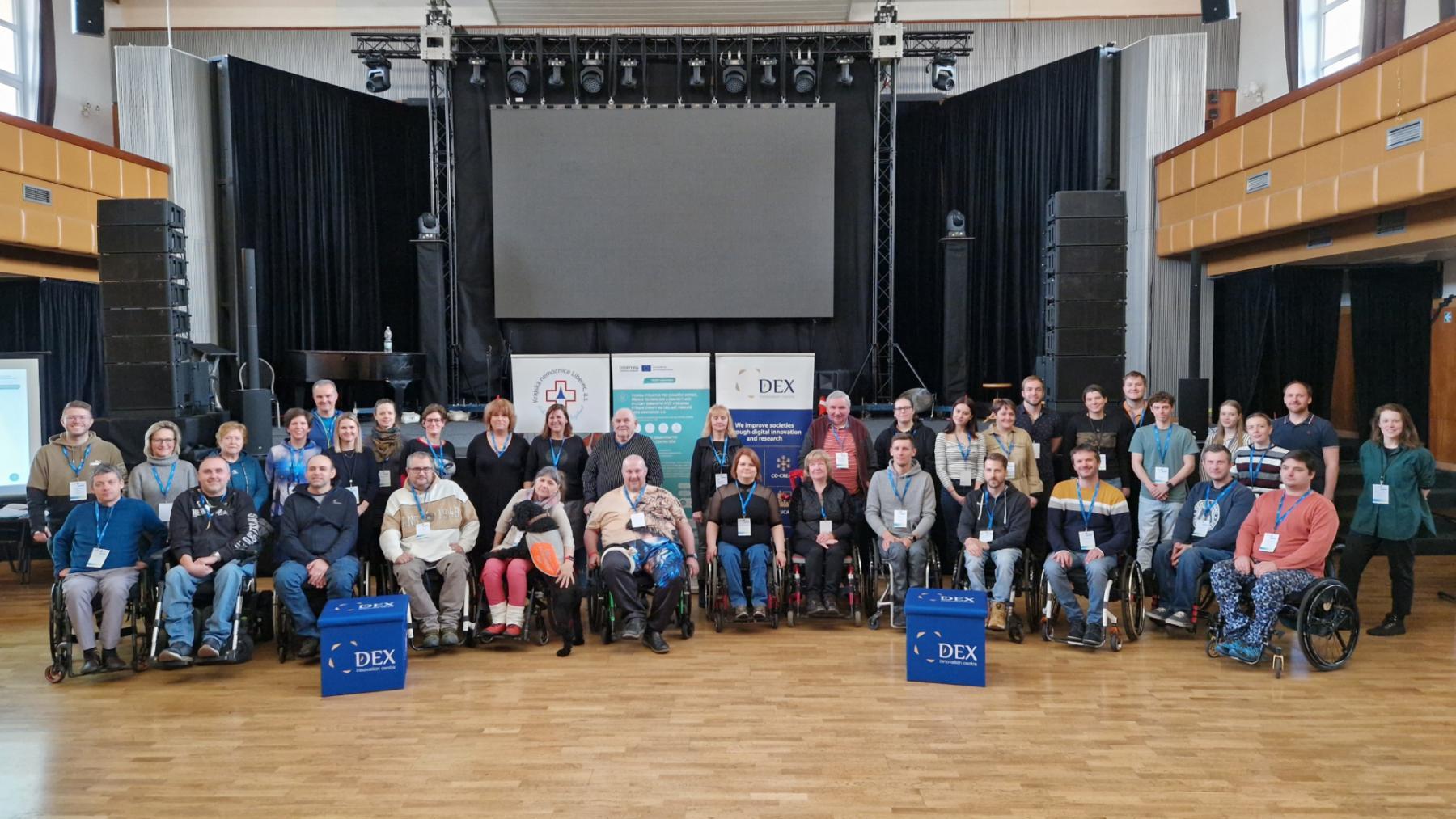
Rovinka is intended to enable healthcare professionals to monitor patients more effectively and provide them with better, continuous education. At the same time, it will ensure mutual contact when a risky health situation arises. The team at Liberec Regional Hospital has the support of both patients and the expert spinal care community in the Czech Republic, which welcomes the tool and believes in its benefits.
At the same time, Rovinka shows what the HealthLabs4Value project, funded by the Interreg Central Europe programme, was primarily about: creating a Living Lab, a real world environment for developing and introducing innovation with the involvement of all key stakeholders. In this case, patients, healthcare professionals, start-ups, academics, social care providers and patient organisations.
A telling detail of the whole effort is the app’s name. It was coined by one of the project team members, who spent dozens of hours over the course of three years talking with patients. It refers to a smoother journey through life, with the app as a companion that helps prevent obstacles and setbacks.
As a successful example of synergy in healthcare practice, the Liberec Regional Hospital team will present the app at the upcoming TechCare 2026 conference in Liberec.
Reforms for people
European healthcare systems are facing structural challenges: an ageing population, a rise in chronic diseases, staff shortages and increasing costs. Traditional reforms often fail when they focus on costs and the volume of reported care rather than on the outcomes that truly matter to people.
The authors of the HealthLabs4Value project set out to change this logic. Over the course of three years, the project connected the principles of Value Based Healthcare with the Living Labs methodology. As a result, five interconnected sites were established in the Czech Republic, Germany, Poland, Slovenia and Hungary. Together, they created cooperative innovation ecosystems in which patients, healthcare professionals, technology suppliers and academics co developed innovative solutions for better healthcare. At the same time, they tested them directly in real world settings.
“Our goal was not to create isolated pilots. We wanted to build living structures, networks, capacities and trust that would enable healthcare systems to learn how to innovate together,” says the project’s lead partner, Dr Ákos Szépvölgyi.
What was achieved in Liberec with the Rovinka app had its parallels in other regions as well. In the other four regions, the Living Labs delivered tangible results, from a digital solution supporting rehabilitation in Slovenia to the ActiveTEP solution for hip surgery in Germany, the redesign of work processes in Hungary and a biometric signature innovation in Poland. Each regional site was firmly embedded in its local healthcare ecosystem while following a shared logic based on the principles of value based care.
The project results show that value based redesign improves not only treatment outcomes, but also reduces staff workload and increases the efficiency of the healthcare system as a whole.