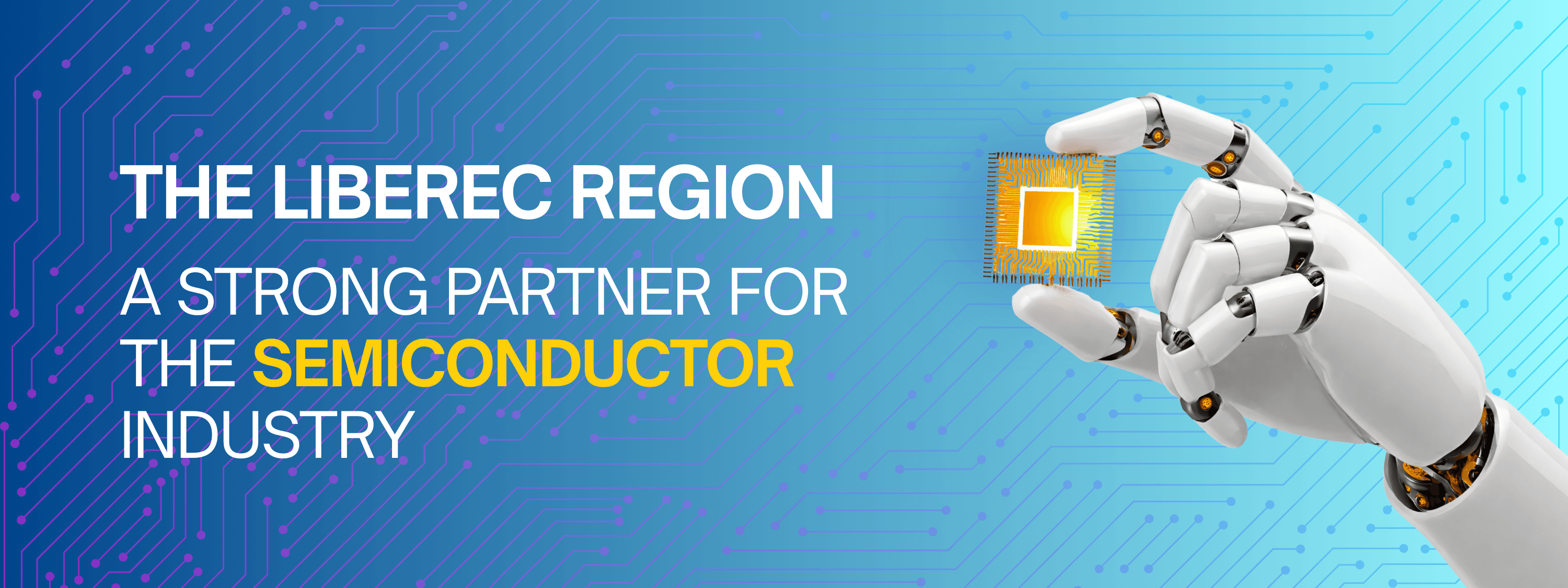
TUL – the Technical University of Liberec as the heart of the regional ecosystem
What role does TUL play in semiconductors
TUL does not operate a single narrowly defined “semiconductor” field of study. Instead, across its faculties and centers, it educates specialists and develops technologies that are essential for the semiconductor industry and its supply chain, including:
development and design of advanced microelectronic systems,
materials research and characterization of the physical and chemical properties of materials,
optical, physical, and electrochemical measurements,
nanomaterials and thin films,
technologies for the treatment of ultrapure process water and wastewater treatment,
digitalization and processing of data from technological processes, including the use of AI.
Key players at TUL
Faculty of Mechatronics, Informatics and Interdisciplinary Studies (FM)
design of printed circuit boards, electronic systems, and software,
research in advanced electronics and systems based on programmable chips (FPGA),
activities in artificial intelligence, software engineering, robotics, and cybernetics for manufacturing systems.
Institute for Nanomaterials, Advanced Technologies and Innovation (CXI TUL)
a multidisciplinary research institute contributing to key parts of the semiconductor ecosystem, including:
development of advanced nanomaterials,
technologies for process water treatment and purification of industrial wastewater, including recycling,
potentially also purification of process gases,
advanced analytical and characterization methods for materials and surfaces.
Department of Physics (KFY)
a broad range of physical, optical, and electrochemical measurements,
research into thin films, nanofibers, interferometry, polarimetry, dielectric properties, and carbon nanomaterials,
know-how transferred directly into teaching, including topics related to quantum phenomena.
Other expert groups focus on:
production and modification of graphene materials (GO/rGO),
photocatalytic materials for water cleaning and treatment,
advanced material and microstructural characterization (ICP, HR SEM, FIB, AFM, EBSD, etc.),
thin-film technologies and surface engineering (PVD, PECVD),
quantum-chemical calculations focused on reaction mechanisms in materials relevant to semiconductor applications.
Study programs and talent
TUL offers several study programs that are especially relevant to the semiconductor ecosystem:
Applied Sciences in Engineering (CZ) – focused on materials research, testing, characterization, and optics/optoelectronics.
Mechatronics (CZ/EN) – prepares specialists for manufacturing industry, with emphasis on robotics, advanced control, and cyber-physical systems. A specialization with a focus on semiconductor manufacturing is being prepared in cooperation with foreign universities.
Nanotechnology (CZ) – focused on nanomaterials, thin films, nanoparticles, and their analysis.
Graduates of these programs find employment in:
electronics manufacturing and development,
advanced physical measurements and testing,
management and optimization of manufacturing processes.
CXI also participates in doctoral study programs and has top-tier equipment that can be used for both academic and industrial projects.
TUL research infrastructure
TUL has a range of equipment and laboratories that can be directly used in cooperation with the semiconductor industry, including:
development boards and server accelerators with advanced FPGAs for custom IC prototyping,
a 3D printer for printed circuit boards for rapid PCB prototyping,
a scanning electron microscope with a focused ion beam (FIB) for structural cross-sections and micro-/nanostructuring,
deposition equipment (PVD, PECVD),
optical and electrochemical laboratories,
a femtosecond laser for material preparation and modification,
ICP and other analytical tools for elemental analysis, including trace contaminants,
advanced SEM, AFM, EBSD, microanalysis, and mechanical and physical testing methods for thin films.
International cooperation and networking at TUL
TUL is involved in a number of international activities related to semiconductors, including:
cooperation of the Faculty of Mechatronics with National Cheng Kung University (Taiwan) and Bar-Ilan University (Israel) in the areas of education, manufacturing technologies, design, and cryogenics,
preparation of an English-language bachelor’s program in mechatronics for manufacturing, with a focus on semiconductors, in cooperation with Hochschule Zittau/Görlitz,
exchange of students and staff within Erasmus and the RUN-EU initiative,
a planned conference in Liberec focused on semiconductor technologies and related topics (tentatively scheduled for late 2026 / early December 2026) as a platform for bringing together academia, industry, and other partners.
TUL also offers professional site visits for industrial and international partners (robotics, PCB printing, optics, photocatalytic materials, graphene, microscopy, thin films, and more).
TUL contact email for cooperation in semiconductors: semi@tul.cz / polovodice@tul.cz
Be with us. Be part of what’s next.




The 1012plus.cz portal has been implemented within the framework of “Smart Akcelerator II Libereckého kraje” project CZ.02.2.69/0.0/0.0/18_055/0016369.
Smart Akcelerator II Libereckého kraje has been implemented by ARR s.r.o. and it has been funded using the European Union funds, the Ministry of Education, Youth and Sport of the Czech Republic and Liberec Region. © ARR spol. s r.o., U Jezu 525/4, 460 01 Liberec